Sightsmap

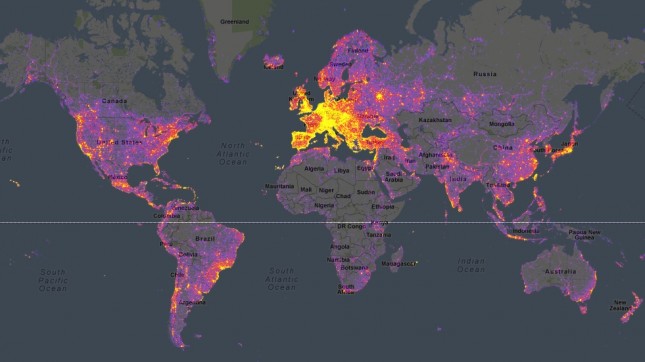
Using geo data from photos uploaded by users to Google’s Panoramio, Sightsmap generates an interactive heatmap of the most frequently photographed spots around the world. It reminds me a little of the Heat Map I made back in 2006, which could be applied to any geolocational data (including photos).

Pantone Moods Trends

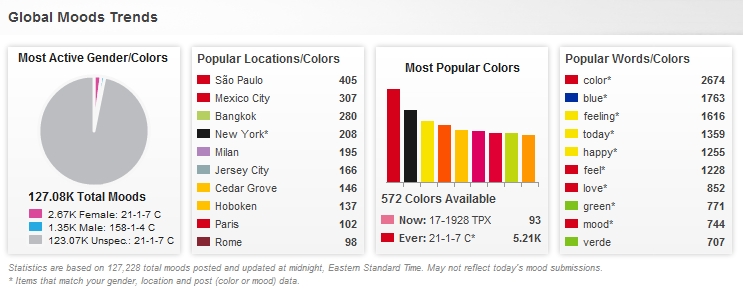
As part of the newly launched Pantone Moods Facebook application, the world-renowned color gurus asked us how we could make the social phenomenon (a quarter million moods have been posted, to date) more exciting for users. Color enthusiasts have had the ability to share their emotions and tag them with Pantone color chip values for the past three years. However, in addition to tripling the color selections (Pantone GOE, and, now, Pantone Plus and Fashion + Home libraries) and and interacting with other members, mood-posters now have the ability to share their gender and location information with the world of users online. In league with OKCupid Trends and Mint Data, Pantone Moods users can see who has posted similar moods and color chips. They can even filter down by Facebook location, gender and time of post to see whose emotional spectrum is the closest to their own.  Read more

2011 – The Year Everything Changed at FWA

Up until February 2007, FWA had almost entirely been awarding Flash websites. For 7 years, every day, a new Site Of The Day (SOTD) was being announced and it was always, almost completely, Flash deployed. The team at Ogilvy Singapore changed everything when they submitted Levi’s Copper Jeans and it went on to win SOTD on 21st February 2007. This site still stands shoulder to shoulder with the best non-Flash sites of 2011 and will always stand out as the seed of change at FWA.

For the next three years we saw the occassional plugin free site win an FWA but in 2010, the playing field was destroyed when The Wilderness Downtown landed on the FWA judges. The interactive short film immediately earned its place in FWA history as it went on to win Site Of The Year (SOTY) for 2010. Whilst raising a lot of eyebrows amongst some of FWA’s hardcore fans, I know personally and amongst the judges for SOTY that there was no doubt that Arcade Fire’s “We Used to Wait” promo site had raised the bar to a level we were not quite expecting.

2011… when everything REALLY DID change at FWA

Read more…

Category: Web

Window Focus and Blur

In working on the new Pantone Moods this week, I needed to add a listener to the widget to halt the realtime updates if a user no longer had the page active (meaning, they switched to another browser tab or application) to prevent unnecessary traffic to the server.

The application cycles through the ten most recent Moods posts and, upon nearing the end of its cache, queried the server for a new supply. However, if someone’s focus wasn’t on the page, it makes no sense to keep collecting and displaying results.

With ActionScript 3, this task is quite easy:

stage.addEventListener(Event.DEACTIVATE, onDeactivate);
stage.addEventListener(Event.ACTIVATE, onActivate);

And it’s just as easy when programming for Mobile Applications:

NativeApplication.nativeApplication.addEventListener(Event.ACTIVATE, onActivate);
NativeApplication.nativeApplication.addEventListener(Event.DEACTIVATE, onDeactivate);

With JQuery, we can now accomplish the same thing for AJAX/PHP browser applications to no longer commit resources to updating a page that isn’t being viewed:

$(function(){
	$(window).bind('blur', function(){
		onDeactivate();
	});
 
	$(window).bind('focus', function(){
		onActivate();
	});
	// IE EVENTS
	$(document).bind('focusout', function(){
		onDeactivate();
	});
	$(document).bind('focusin', function(){
		onActivate();
	});
});

Note that the second two methods must be added because Internet Explorer uses focusin/focusout rather than simply focus/blur.
The do’s and don’ts of Flash

This article was originally published on the Firstborn site on July 1, 2011, and is written by my buddy and Flash guru, Zeh Fernando:

The do’s and don’ts of Flash

Zeh Fernando, senior developer at Firstborn, rounds up the ultimate do’s and don’ts of Flash to explain how we can improve our workflow to create powerful, rich online experiences more efficiently.

Developing fully interactive websites is an amazing experience whose technology is in a current state of change.  We’re not only seeing big changes in terms of platforms used for that purpose – HTML5 anyone? – but also in the workflow employed when developing those (so called) rich websites.I think that Flash is a particularly acute example of the latter.  The platform has evolved a lot through the years, not only in regards to what it can do, but in how one should do it.  In that sense, the rich online experiences we create can now be more powerful than ever, so here’s a few pointers on how to get it done a little more efficiently.

Read more…

Category: Web