[d]online Index

On January 18, 2006—exactly six years ago—I started this blog. Since then, there have been:

  • •  1729 Posts (this one included)

  • •  66,502 Comments

  • •  254 Informational Posts

  • •  24 Code Examples

  • •  17 Prose Posts

  • •  16 Rants/Diatribes (oops, sorry!)

  • •  13 Technology Review Posts

  • •  11 Poetry Posts

  • •  9 Versions of the Flash File Uploader

  • •  4 Original Videos

  • •  2 Original Typefaces


I am a little shaken by how much time I spend on this blog.
*goes outside for the first time in 6 years*

Google Class Action Suit Settlement

I found this incredibly fascinating and wondered if Facebook and Zinga, or other social networking applications and sites will follow suit with class action suit settlements. This is a momentous achievement for those who feel helpless that participating in social networking automatically forfeits their privacy. What do you think?

Google rarely contacts Gmail users via email, but we are making an exception to let you know that we’ve reached a settlement in a lawsuit regarding Google Buzz (http://buzz.google.com), a service we launched within Gmail in February of this year.

Shortly after its launch, we heard from a number of people who were concerned about privacy. In addition, we were sued by a group of Buzz users and recently reached a settlement in this case.

The settlement acknowledges that we quickly changed the service to address users’ concerns. In addition, Google has committed $8.5 million to an independent fund, most of which will support organizations promoting privacy education and policy on the web. We will also do more to educate people about privacy controls specific to Buzz. The more people know about privacy online, the better their online experience will be.

Just to be clear, this is not a settlement in which people who use Gmail can file to receive compensation. Everyone in the U.S. who uses Gmail is included in the settlement, unless you personally decide to opt out before December 6, 2010. The Court will consider final approval of the agreement on January 31, 2011. This email is a summary of the settlement, and more detailed information and instructions approved by the court, including instructions about how to opt out, object, or comment, are available at http://www.BuzzClassAction.com.

——————————————————————–
This mandatory announcement was sent to all Gmail users in the United States as part of a legal settlement and was authorized by the United States District Court for the Northern District of California.

Google Inc. | 1600 Amphitheatre Parkway | Mountain View, CA 94043

4G in NYC

This is the first day my HTC Evo has allowed me to connect to the 4G network in both Manhattan and Hoboken. Needless to say, I’m pretty excited, though I haven’t seen much of a difference yet. So far, my favorite part was to be able to rub it in Zeh‘s face as his Nexxus One isn’t 4G capable.

Spam-blocking sub-domains

A long time ago, around the time I started compiling my “Best Practices…” list, I began creating forwarders for ecommerce accounts to distinguish who was sending me solicitations and to be able to stop them easily. If you give someone your email address, say “joe@joe-co.com” then you have no idea where the soliciations are coming from and the only way to stop them is to increase your SpamAssassin rating—potentially losing false positives—or to get a new email address.

But, if you create “hsbc@joe-co.com,” and forward that to “joe@joe-co.com,” you can see who sold your email address and promptly disrupt the flow of spam by simply deleting the forwarder. Well, after a decade of online business through my company, ERA404, I have a veritable bee’s hive of forwarders floating around. And, as I’d like to do some house-keeping to keep them organized, I’ve decided to create a sub-domain to create easily visual recognition of what is an actual forwarder (i.e., don@ forwards to don.citarella@) and what is a spam-blocking forwarder (i.e., hsbc@ temporarily forwards to don.citarella@).

Here’s where I need your assistance. Fill in the blank:
Solicitor: “Sir, in order for me to process your order, you need to provide a valid email address.”
Me: So I’d like to provide them with: “[solicitor name]@_____.era404.com” where ______ is the word I’m seeking.

Here are a few that I thought of: @firewall, @temporary, @spam, @commerce, @solicitations, @junkmail, @junk, @delete, @block, @protect, @safe, @safety, @protection, @temp.

Here are a few suggestions by friends: @refuse, @trash, @scrap, @waste, and my personal favorite, @is-a-dirty-dirty-whore. (Imagine providing the following: “The email address is: hsbc@is-a-dirty-dirty-whore.joe-co.com“). Ah, it’s the little things in life. It truly is.

So I appeal to you, gentle readers. What would be the best spam-blocking sub-domain? While my preference is to go with @solicitations, I worry it will be too long: networksolutions@solicitations.joe-co.com. And does @trash have that certain je ne sais quoi that I want, so that solicitors think “I see what you did there. Well played, dear sir. Well played.“?

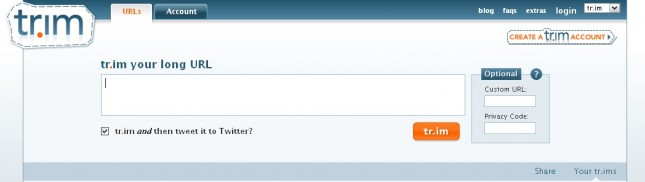
tr.im returns

I was sad to see that tr.im was shut down, quite unprofessionally, back in early August. And since then, the world moved on without them and everyone forgot they ever existed in the first place. In fact, if it wasn’t for a random twitter post by them yesterday, I would’ve never learned that they apologized:

Everyone involved at Nambu would like to apologize again for the hastiness in which we acted last Sunday, announcing the shutdown of tr.im by the end of the year.

…they regrouped, and are now transitioning to being open source and community-owned.

…and you have Eric Woodward‘s personal guarantee that he’ll take care of shortfalls in funding to ensure that tr.im never goes offline again.