Google Latitude Location History

Google Latitude Location History

When I was a little kid, I always imagined that, after we die, we’d have the opportunity to visit a pavilion in heaven that traced a line through all our travels on earth. Google Latitude’s Location History can now do this, for one-month periods. It tracks your phone’s GPS signal along with stops along the way. And while this may be a little invasive from a Big Brother standpoint, it’s also quite helpful to notify friends and family of your impending arrival and track a missing or stolen cell phone to it’s current location.

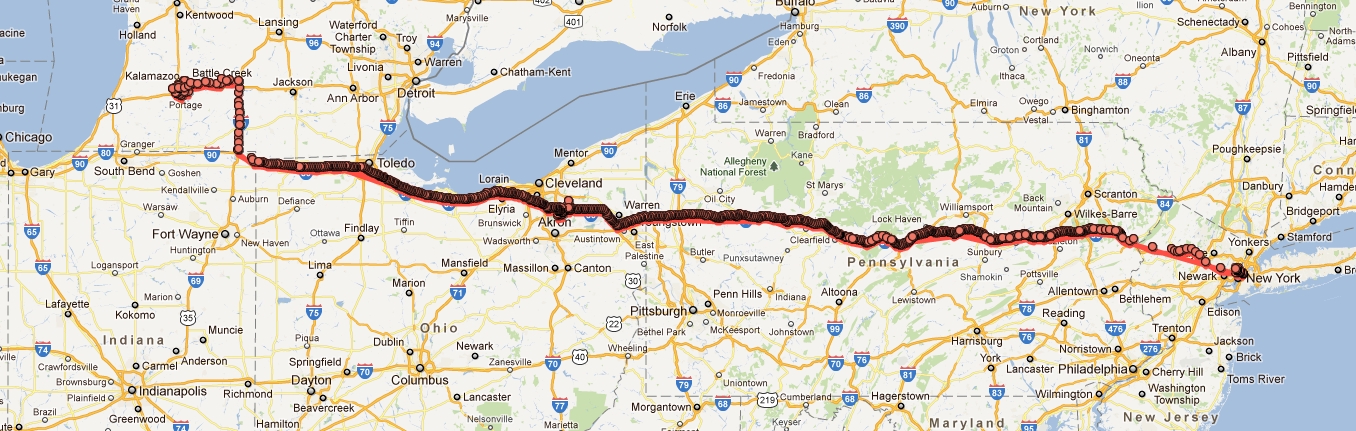
Above, you can see a recent road trip to Michigan with a brief overnight stop in Ohio. The frequency of the dot seems fairly random but factors in speed, signal strength and delays. My five-hour traffic jam outside the Poconos is clearly present by a cluster of rather impatient looking dots. You can also see a kopse of dots denoting my meandering through Kalamazoo, my final destination. Keep in mind this journey retraces into itself for both legs of the trip. In this view, it’s difficult to tell which dot is for the westward vs. the eastward leg. Maybe the next version of Google Latitude Location History will overlay time.


Google Plus Contacts Flooding Google Talk

It took me a little while to find this, so I thought it might be helpful to post it on [d]online in case others are having the same issue.

After signing up for Google Plus, I noticed that my Pidgin contact list was getting flooded with contacts. Many of those contacts had a Google Plus email address rather than a normal one. I’d recognized a few names but not all of them. So I went to Google Plus and realized that these were all contacts that were in my Circles – friends of friends, subscription lists, companies under profiles of users, etc.

If I clicked “Block Friend,” “Remove Friend,” and/or “Hide Friend” from Pidgin, Google Talk (on my Android) or Google Talk on my Gmail sidebar, the users either remained in the list or disappeared until the next time I logged in. As you can probably imagine, it’s frustrating to see a wealth of users flooding a buddy list when they’re not, indeed, buddies.

After poking around online, I found a number of other users were dealing with the same issues. I tried a few recommendations and hacks, recommended by some of the more proficient users, but none of them seemed to work. Finally, I landed on a post in a Google Plus Help forum that seemed to do the trick. If you’re experiencing the same issues, try the following: Read more

Free, Online

As we all know too well, free doesn’t always mean free. How often have you clicked on a link in emails or from search results only to be brought to a page that informs you that you must enter a credit card or complete a series of obstacles in order to get access to the elusive free product? Television offers for games, such as McDonald’s Monopoly game, always boast the “no purchase necessary” option to play. Gevalia touts a free percolator while also subscribing you to a coffee-o-the-month club for outrageously overpriced java. And dozens of pop-up “Free iPad” sites require you to enlist friends, sign-up for credit cards or buy magazine subscriptions in order to qualify for free products that you probably will never see. In fact, most spam blockers specifically look for the word “free” in the subjects or bodies of emails to elevate the email’s spam ranking simply because they know that free, online, isn’t always free. Free, online, means “free trial,” “free if you enter a credit card,” “free if you complete these tasks,” and “free*“. Read more

Vincent Van Gogh’s Starry Night Interactive by Petros Vrellis

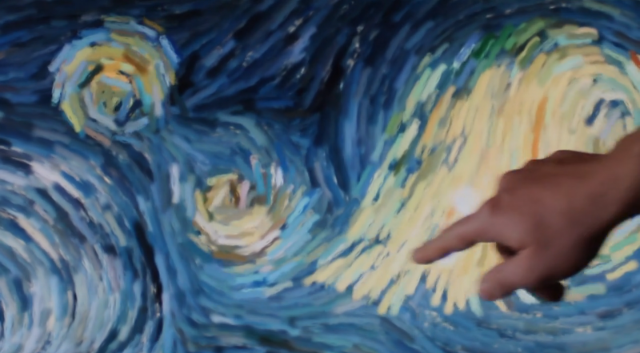
Petros Vrellis has created an interactive visualisation and synthesizer that animates Vincent Van Gogh’s “Starry Night”, using openframeworks to create a simple and elegant interaction. A fluid simulation gently creates a flowing fabric from Van Goghs impressionist portrait of the Milky Way and night sky over Saint-Rémy in France using the thick paint daubs as the particles within the fluid.

A touch interface allows a viewer to deform the image, altering both the flow of the particles and the synthesized sound, and then watch it slowly return to its original state. The sound itself is created using a MIDI interface to create a soft ambient tone out of the movement of the fluid that underscores the soft movement. Beauty through simplicity at its finest and most playful.

I’m a little embarrassed to admit that the video brought tears to my eyes.